
Active Crankcase Ventilation Systems (ACCVS) for heavy-duty and commercial vehicles
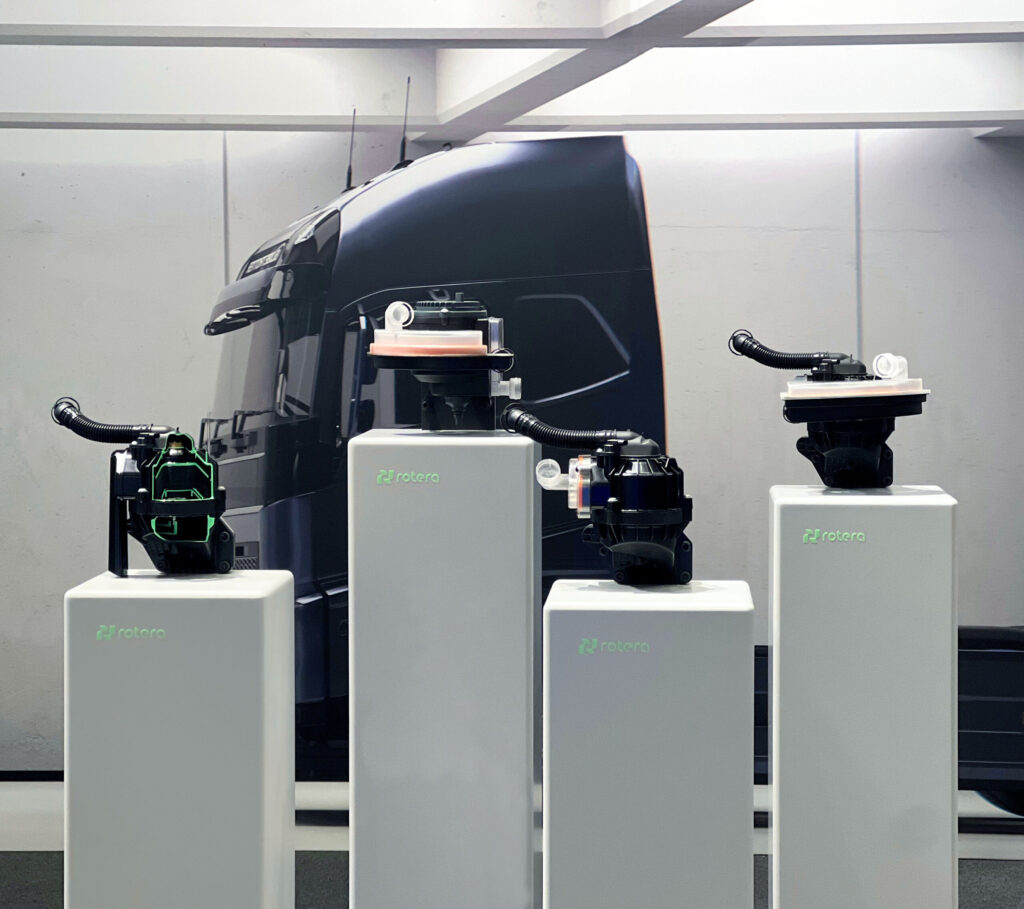
Rotera’s Active Crankcase Ventilation Systems (ACCVS) are based on our patented Disc Stack Separation Technology that continuously separates oil particles from blow-by gases. Our compact solutions for crankcase ventilation achieve separation efficiency close to 100% and are suited for all commercial vehicles and heavy-duty combustion engines, including trucks, vans, and busses.
Rotera Disc Stack Technology
Rotera’s Disc Stack Separation Technology consists of a rotor with conical discs stacked onto each other, which is driven either electrically or hydraulically. Blow-by gas gets pushed and sucked into the rotor and forced through the gaps between the single discs of the stack. Due to flow and centrifugal force, the captured particles move towards the surface of the nearest rotating disc and coalesce with each other. The separated particles are forced to the outer edge of each disc and are then thrown onto the inner wall of the rotor chamber.
Clean gas is vented either to the atmosphere (OCV) or back to the engine intake manifold (CCV); the separated oil is fed back to the oil recirculation system.
New Disc Stack Technology combined with filter element
Our Disc Stack Separation Technology provides one of the highest separation rates on the market. To reach even higher efficiency rates, our latest patented innovation combines Disc Stack Separation Technology with a highly efficient downstream filter. This ensures close to particle-free emissions, where even most of the finest particles (<0.6μm) are removed. We developed this solution to support our global customers who strive to meet stricter emission regulations adopted by commissions such as the European Commission and CARB.

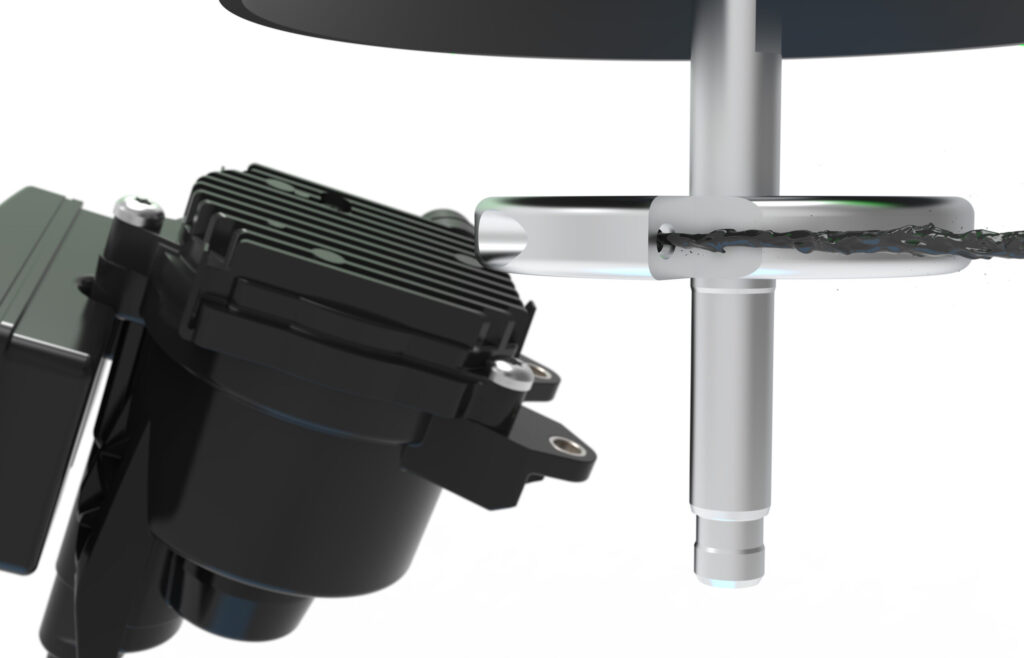
The disc stack separators can be either driven by a BLDC motor or hydraulics. The robust BLDC motor is designed as a lifetime component and includes electronics to communicate with the ECU. It can be driven by 12V or 24V and communicates via PWM or CAN, as standard for heavy-duty and commercial vehicles. Our hydraulic drive is a patented innovation based on the Heron turbine principle with a contactless seal between the drive and rotor chamber. The system gets fed by engine oil from the oil circuit, which flows through the hollow drive axle, goes up to the turbine, and out through the radially located nozzle. When it passes through the nozzle, the disc stack separator starts to rotate because of the repulsion effect and can reach a speed up to 12,000 rpm. The advantage with the hydraulic drive is that it is insensitive to vehicle vibrations, a common issue of the hydraulic drive solutions competitors use.
Drive Systems
The disc stack separators can be either driven by a BLDC motor or are moved hydraulically. The robust BLDC motor is designed as a lifetime component and includes electronics to communicate with the engine ECU. It can be powered by 12V or 24V and communicates preferentially via LIN, the standard for light vehicles. Our patented system for hydraulic drive HERON is based on the HERON turbine system with a contactless seal between the drive and rotor chamber. The system gets fed by engine oil from the oil circuit, which flows through the hollow drive axle, goes up to the turbine, and out through the radially located nozzle. When it passes through the nozzle, the disc stack separator starts to rotate because of the repulsion effect and can reach speeds up to 16,000 rpm.
Patented Guiding Ribs
To prevent separated oil particles from being accompanied by the purified gas out of the separator, Rotera developed and patented unique guiding ribs. In combination with the stream of the rotating gas inside the separation chamber, these ribs ensure that the separated oil droplets get pushed down to the bottom of the rotor chamber, where the oil is then fed out and back to the engine oil circuit.

For all type of fuels
Engines and vehicle models have varying requirements for crankcase ventilation systems which is why we offer customized designs, products, and solutions. Our systems for crankcase ventilation are designed for traditional combustion engines but can be adapted to the specific demands of engines running with natural gas, bio-fuels, or e-fuels such as hydrogen.